Radical 2
| 丨 | ||
|---|---|---|
| ||
| 丨 (U+4E28) "line, stick" | ||
| Pronunciations | ||
| Pinyin: | gǔn | |
| Bopomofo: | ㄍㄨㄣˇ | |
| Gwoyeu Romatzyh: | goen | |
| Wade–Giles: | kun3 | |
| Cantonese Yale: | kwán | |
| Jyutping: | kwan2 | |
| Pe̍h-ōe-jī: | khún | |
| Japanese Kana: | コン kon (on'yomi) ぼう bō (kun'yomi) | |
| Sino-Korean: | 곤 gonn | |
| Hán-Việt: | cổn | |
| Names | ||
| Chinese name(s): | 豎/竖/竪 shù | |
| Japanese name(s): | 棒/ぼう bō (stick) 縦棒/たてぼう tatebō (vertical stick) | |
| Hangul: | 뚫을 tturheul | |
| Stroke order animation | ||
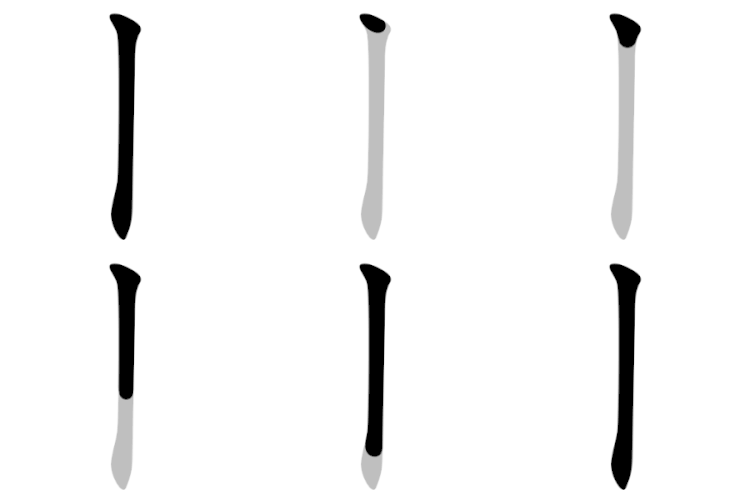 | ||
Radical 2 or radical line (丨部) meaning "vertically connected"[1] is one of 6 of the 214 Kangxi radicals that are composed of only one stroke.
In the Kangxi Dictionary, there are only 21 characters (out of 49,030) to be found under this radical.
丨 is also the 2nd indexing component in the Table of Indexing Chinese Character Components predominantly adopted by Simplified Chinese dictionaries published in mainland China, with 亅 being its associated indexing component (used to be associated with 乛 prior to the new standard in 2009).
Evolution
-
 Large seal script character
 -
 Small seal script character
Derived characters
| Strokes | Characters |
|---|---|
| +0 | 丨 |
| +1 | 丩 |
| +2 | 个SC/variant (=個 -> 人) 丫 |
| +3 | 中 丮 丯 丰SC/JP/丰TC (also SC/JP form of 豐 -> 豆) 书SC (=書 -> 曰) |
| +4 | 丱 |
| +6 | 串 |
| +7 | 丳 |
| +8 | 临SC (=臨 -> 臣) |
| +9 | 丵 |
In calligraphy

The only stroke in radical line, known as 豎/竖/竪 shù "vertical", is called 努 nǔ in the eight principles of the character 永 (永字八法 Yǒngzì Bāfǎ) which are the basis of Chinese calligraphy.
Literature
- Fazzioli, Edoardo (1987). Chinese calligraphy : from pictograph to ideogram : the history of 214 essential Chinese/Japanese characters. calligraphy by Rebecca Hon Ko. New York: Abbeville Press. ISBN 0-89659-774-1.
- Leyi, Li (1993). Tracing the Roots of Chinese Characters: 500 Cases. Beijing. ISBN 978-7-5619-0204-2.
{{cite book}}: CS1 maint: location missing publisher (link)
References
- ^ 《說文解字》:“丨,上下通也。” Shuowen Jiezi: "丨" means vertically connected.
External links

Wikimedia Commons has media related to Radical 002.
Simplified Chinese characters radicals (indexing components) | |
|---|---|
| 1 stroke | |
| 2 strokes | |
| 3 strokes | |
| 4 strokes | |
| 5 strokes | |
| 6 strokes | |
| 7 strokes | |
| 8 strokes | |
| 9 strokes | |
| 10 strokes | |
| 11 strokes | |
| 12 strokes | |
| 13 strokes | |
| 14 strokes |
|
| 17 strokes |
|
GF 0011-2009 Table of Indexing Chinese Character Components prescribes 201 principle indexing components and 100 associated indexing components (in brackets) used in Simplified Chinese. Not all associated indexing components are listed above. | |


