Radical 156
| 走 | ||
|---|---|---|
| ||
| 走 (U+8D70) "run" | ||
| Pronunciations | ||
| Pinyin: | zǒu | |
| Bopomofo: | ㄗㄡˇ | |
| Wade–Giles: | tsou3 | |
| Cantonese Yale: | jau2 | |
| Jyutping: | zau2 | |
| Japanese Kana: | ソウ sō (on'yomi) はし-る hashi-ru (kun'yomi) | |
| Sino-Korean: | 주 ju | |
| Hán-Việt: | tẩu, rảo | |
| Names | ||
| Chinese name(s): | 走字底 zǒuzìdǐ | |
| Japanese name(s): | 走/はしる hashiru | |
| Hangul: | 달릴 dallil | |
| Stroke order animation | ||
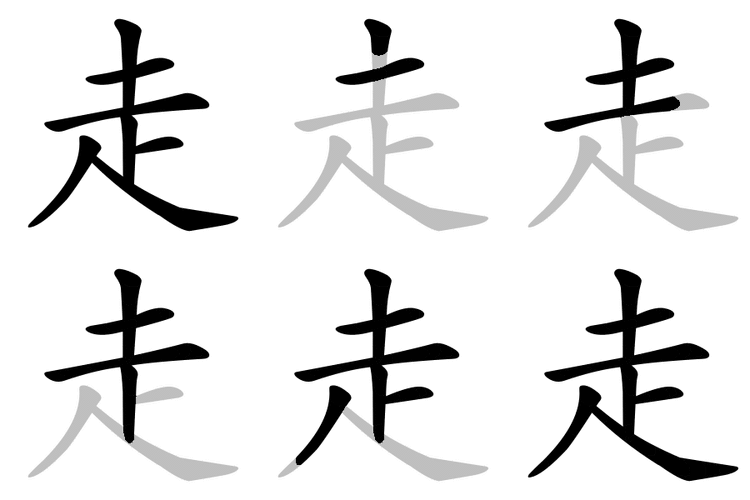 | ||
Radical 156 or radical run (走部) meaning "run" is one of the 20 Kangxi radicals (214 radicals in total) composed of 7 strokes.
In the Kangxi Dictionary, there are 285 characters (out of 49,030) to be found under this radical.
走 is also the 150th indexing component in the Table of Indexing Chinese Character Components predominantly adopted by Simplified Chinese dictionaries published in mainland China.
Evolution
-
 Oracle bone script character
 -
 Bronze script character
 -
 Large seal script character
 -
 Small seal script character
Derived characters
| Strokes | Characters |
|---|---|
| +0 | 走 赱 (=走) |
| +2 | 赲 赳 赴 赵SC (=趙) |
| +3 | 赶SC (=趕) 起 赸 |
| +4 | 赹 赺 赻 赼 (=趑) 赽 赾 赿 (=遲 -> 辵) |
| +5 | 趀 趁 趂 (=趁) 趃 趄 超 趆 趇 趈 (=站 -> 立) 趉 越 趋SC (=趨) |
| +6 | 趌 趍 趎 趏 趐 趑 趒 趓 (=躲 -> 身) 趔 |
| +7 | 趕 趖 趗 趘 趙 趚 |
| +8 | 趛 趜 趝 趞 趟 趠 趡 趢 趣 趤 |
| +9 | 趥 趦 趧 |
| +10 | 趨 |
| +12 | 趩 趪 趫 趬 趭 |
| +13 | 趮 |
| +14 | 趯 趰 |
| +16 | 趱SC (=趲) |
| +19 | 趲 |
Sinogram
As an independent sinogram 走 is one of the Kyōiku kanji or Kanji taught in elementary school in Japan.[1] It is a second grade kanji.[1]
References
- ^ a b "The Kyoiku Kanji (教育漢字) - Kanshudo". www.kanshudo.com. Archived from the original on March 24, 2022. Retrieved 2023-05-06.
Further reading
- Fazzioli, Edoardo (1987). Chinese calligraphy : from pictograph to ideogram : the history of 214 essential Chinese/Japanese characters. calligraphy by Rebecca Hon Ko. New York: Abbeville Press. ISBN 0-89659-774-1.
- Lunde, Ken (Jan 5, 2009). "Appendix J: Japanese Character Sets" (PDF). CJKV Information Processing: Chinese, Japanese, Korean & Vietnamese Computing (Second ed.). Sebastopol, Calif.: O'Reilly Media. ISBN 978-0-596-51447-1.
External links

Wikimedia Commons has media related to Radical 156.
Simplified Chinese characters radicals (indexing components) | |
|---|---|
| 1 stroke | |
| 2 strokes | |
| 3 strokes | |
| 4 strokes | |
| 5 strokes | |
| 6 strokes | |
| 7 strokes | |
| 8 strokes | |
| 9 strokes | |
| 10 strokes | |
| 11 strokes | |
| 12 strokes | |
| 13 strokes | |
| 14 strokes |
|
| 17 strokes |
|
GF 0011-2009 Table of Indexing Chinese Character Components prescribes 201 principle indexing components and 100 associated indexing components (in brackets) used in Simplified Chinese. Not all associated indexing components are listed above. | |


