Moru–Madi languages
| Moru–Madi | |
|---|---|
| Geographic distribution | South Sudan, Uganda, and the DRC |
| Linguistic classification | Nilo-Saharan?
|
| Language codes | |
| Glottolog | moru1252 |
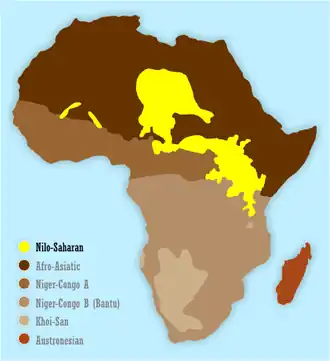
The Moru–Madi languages of the Central Sudanic language family are a cluster of closely related languages spoken in South Sudan, the Democratic Republic of Congo, and Uganda. Moru is spoken by 100,000 people, and Maʼdi is spoken by twice that number. The most populous languages are Aringa of Uganda, with close to a million speakers, and Lugbara, with 1.6 million.
Languages
The languages in this cluster are found across three countries: Uganda (Maʼdi, Lugbara, Aringa, S. Maʼdi); South Sudan (Aringa, Maʼdi, Loluʼbo, Avukaya, Kaliko, Moru, and Logo); and the Democratic Republic of Congo (Lugbara, Avukaya, Kaliko, and Logo).
- Moru (Waʼdi variety divergent)
- Avokaya
- Keliko
- Omi
- Lugbara
- Okollo–Ogoko–Rigbo
- Logo
- Aringa (Lower Lugbara)
- Maʼdi (Moyo, Adjumani (Oyuwi), Pandikeri, Lokai, Burulo dialects)
- Oluʼbo (Lolubo)
The name Maʼdi
The name Maʼdi is used for various peoples in the region. There is a tendency, especially in the Acholi region of northern Uganda, to refer to anyone from West Nile Region as a Maʼdi, even the Kakwa. The only group in this region who are never called Maʼdi are the Alur.
Joseph Pasquale Crazzolara,[1] for example, states that "all Logbara [...] agree that they are of the Maʼdi nation, that they are Maʼdi. They are called Maʼdi by the Alur of Okooro, their immediate neighbours, in Bunyoro and Buganda." Similarly, the linguist A. N. Tucker described the neighboring Keliko people who occupy the high plateau near the Logbara, as having the "real name Maʼdi".[2] However, the Keliko regard themselves as Keliko rather than as Maʼdi.
Comparative vocabulary
Sample basic vocabulary of Moru–Madi languages from Boone & Watson (1996):[3]
| Language | Dialect | eye | ear | nose | tooth | tongue | mouth | blood | bone | tree | water | eat | name |
|---|---|---|---|---|---|---|---|---|---|---|---|---|---|
| Moru | Kâdiro | mi | bi | kʊmvʊ | si | laɖa | kala | kari | kʊwa | cɛ | jǐ | ɔɲa | ʌvuru |
| Moru | Lakamadi | mi | bi | kʊmvʊ | si | laɖa | kala | kari | kʊwa | icɛ, cɛ | jǐ | ɔɲa | ʌvuru |
| Moru | Miza | mi | bi | kʊmvʊ | si | laɖa | kala | kari | kʊwa | icɛ, cɛ | jǐ | ɔɲa | ʌvuru |
| Moru | Âgyi | mi | bi | kʊmvʊ | si | laɖa | kala | kari | kʷa | icɛ | ìjí | aɲa | ru |
| Moru | Ândri | mi | bi | imvʊ | si | laɖa | kala | ari | fā | ifɛ | ìjí | ɔɲa | ru |
| Moru | ʼBâriʼbâ | mi | bi | imvʊ | si | laɖa | kala | ari | kʷa | ifɛ | ìjí | ɔɲa | ru |
| Moru | Waʼdi | mi | bi | kʊmvʊ | si | laɖa | ti | kari | kʷa | cɛ | ìjí | aɲa | ru |
| Avokaya | Sudan | lìfí | bí | ɔ̀mvɔ̄ | sí | lànɖā | tī | àrɪ́ | fà | fɛ̄ | lùmvū | ɲà | rú |
| Avokaya | Zaïre | mǐfí | bí | ɔ̀mvɔ̄ | sí | làɖā | tī | àrɪ́ | fà | fɛ̄ | yǐ | ɲà | rú |
| Logo | Ogambi, Doka, Lolia, Obeleba, Bhagira |
mì | bí | kɔ̀mvɔ̄ | sí | làɖā | tī | kàrɪ | fà | fā | yǐ | ɲā | rú |
| Logo Bari | Kanzako | mìkífí | ɓí | kɔ̀mvɔ̄ | sí | làɖā | tī | kàrɪ̄ | fà | fɛ̄ | yǐ | ɲā | rú |
| Logo Bari | West | mì | bí | kɔ̀mvɔ̄ | sí | làɖā | tī | kàrɪ̄ | fà | fɛ̄ | yǐ | ɲā | rú |
| Logo Bari | Mandra | ɲɛ̌fɪ́ | ɓí | ɔ̀mvɔ̄ | sí | làɖā | tī | àrɪ́ | fà | fɛ̄ | ɛ̀yí | ɔ̀ɲā | rú |
| Kaliko | Maʼdi-Didi | mì, mīfí | bí | ɔ̀mvɔ̄ | sí | àɖā | tī | kàrɪ́, àrɪ̀ | fà | fā, fʌ̄tī | yǐ | ɲā | rú |
| Kaliko | Southwest | mī, mīfí | bí | ɔmvɔ̄ | sí | àɖā | tí | àrɪ́ | fā | fɛ́ | yǐ | ɲā | rú |
| Kaliko | Rapaʼba | mī | bí | ɔmvɔ̄ | sí | ālāɖā | tɔ́gʊ́ | àrɪ́ | fà | fɛ́ | yǐ | ɲā | rú |
| Kaliko | Maʼdi-Dogo | mīfí | bí | ɔ̀mvɔ̄ | sí | àɖā | - | - | - | pʌ̀tì | yǐ | ɲā | rú |
| Kaliko | Southeast | mī | bí | ʊ̀mvʊ̄ | sí | áɖā | tī, tí | àrɪ́ | fà | peti | yǐ, ìjí | ɲā | rú |
| Kaliko | Omi | mǐfà | bí | ɔ̀mbɔ̄ | sí | àɖā | tī | àrɪ́ | fàlágɔ́ | fʌ̄tī | yǐ | ɲā | rú |
| Okollo | mule | bí | ōmbʊ́ | sí | áɖā | tílɛ́ | àrɪ́ | cɔ̀ɔ́ | pʌ̄tí | yǐ | ɲá | rú | |
| Ogoko | mìfī | bí | ɔ̀mvʊ̄ | sí | ɪ́ɖɛ̄ | tī | àrɪ́ | cɔ̀kɔ́ | pàtí | yǐ | ɲà | rú | |
| Lugbara | Zaire (Lu, Zaki, Abedzu) | mìlɛ̄ | bí | ɔ̀mvū | sí | aɖa | tī | àrɪ́ | fàlákɔ́ | pʌ̄tí | yǐ | ɲa | rú |
| Lugbara | Uganda (Vurra, Ayivu) | mīlɛ́ | bí | ɔ̀mvʊ̄ | sí | āɖɛ̄ | tī | àrɪ́ | fàlákɔ́ | pʌ̄tí | yǐ | ɲa | rú |
| Maracha | mìfī | bí | ɔ̀mvʊ̄ | sí | ɛ̄ɖɛ̀ | tī | àrɪ́ | fàlákɔ́ | pʌ̀tí | yǐ | ɲá | rú | |
| Terego | mìfī | bí | ɔ̀mvʊ̄ | sí | ɛ̄ɖɛ̄ | tī | àrɪ́ | fàlákɔ́ | pàtíkè | yǐ | ɲá | rú | |
| Aringa | mīfí | bílé | ɔ̀mvʊ̄ | sí | ɪ̀ɖā | tī | àrɪ́ | ìfà | ɪ̀fɛ́ | ìjí | ɲá | rú | |
| Maʼdi | Uganda | mī | bí | ɔ̀mvɔ̄ | sí | lɛ̀ɖá | ti | àrɪ́ | hʷa | kʷɛ | èyí | ɲā | rú |
| Maʼdi | Lokai | mí | bí | ɔ̀mvɔ̄ | sí | lɛ̄dá | tí | àrɪ, ari | kʷà | kʷɛ̄ | ēyí | ɲā | rú |
| Maʼdi | Pandikeri | mí | bí | ɔ̀mvɔ̄ | sí | lɛ̄dá | tí | ɛ̀rɪ | kʷà | kʷɛ̄ | īyí | ɲā | rú |
| Lulubo | mī | bí | ɔmbɔ̄ | sí | lɛ̄dā | tī | ɛ̀rɪ̄ | kʷā | kʷɛ̄ | īyí | ɲā | rú |
References
- ^ Crazzolara, J. P. (2017). A study of the Logbara (Maʼdi) language: Grammar and vocabulary. Routledge. [Originally published 1960]
- ^ The Eastern Sudanic Languages. By A. N. Tucker. vol. I. 434 pp. Oxford University Press, 1940
- ^ Boone, Douglas; Richard L. Watson (editors). 1996. Moru-Maʼdi survey report. Nairobi, Kenya: Summer Institute of Linguistics.
- Nilo-Saharan list (Blench 2000)