Camassa–Holm equation
In fluid dynamics, the Camassa–Holm equation is the integrable, dimensionless and non-linear partial differential equation



The evolution of the individual peakon positions and , as well as the evolution of the peakon amplitudes and is however less trivial: this is determined in a non-linear fashion by the interaction.


The equation was introduced by Roberto Camassa and Darryl Holm[1] as a bi-Hamiltonian model for waves in shallow water, and in this context the parameter κ is positive and the solitary wave solutions are smooth solitons.
In the special case that κ is equal to zero, the Camassa–Holm equation has peakon solutions: solitons with a sharp peak, so with a discontinuity at the peak in the wave slope.
Relation to waves in shallow water
The Camassa–Holm equation can be written as the system of equations:[2]
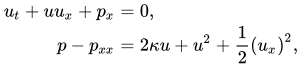
with p the (dimensionless) pressure or surface elevation. This shows that the Camassa–Holm equation is a model for shallow water waves with non-hydrostatic pressure and a water layer on a horizontal bed.
The linear dispersion characteristics of the Camassa–Holm equation are:
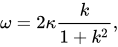
with ω the angular frequency and k the wavenumber. Not surprisingly, this is of similar form as the one for the Korteweg–de Vries equation, provided κ is non-zero. For κ equal to zero, the Camassa–Holm equation has no frequency dispersion — moreover, the linear phase speed is zero for this case. As a result, κ is the phase speed for the long-wave limit of k approaching zero, and the Camassa–Holm equation is (if κ is non-zero) a model for one-directional wave propagation like the Korteweg–de Vries equation.
Hamiltonian structure
Introducing the momentum m as

then two compatible Hamiltonian descriptions of the Camassa–Holm equation are:[3]

Integrability
The Camassa–Holm equation is an integrable system. Integrability means that there is a change of variables (action-angle variables) such that the evolution equation in the new variables is equivalent to a linear flow at constant speed. This change of variables is achieved by studying an associated isospectral/scattering problem, and is reminiscent of the fact that integrable classical Hamiltonian systems are equivalent to linear flows at constant speed on tori. The Camassa–Holm equation is integrable provided that the momentum

is positive — see [4] and [5] for a detailed description of the spectrum associated to the isospectral problem,[4] for the inverse spectral problem in the case of spatially periodic smooth solutions, and [6] for the inverse scattering approach in the case of smooth solutions that decay at infinity.
Exact solutions
Traveling waves are solutions of the form

representing waves of permanent shape f that propagate at constant speed c. These waves are called solitary waves if they are localized disturbances, that is, if the wave profile f decays at infinity. If the solitary waves retain their shape and speed after interacting with other waves of the same type, we say that the solitary waves are solitons. There is a close connection between integrability and solitons.[7] In the limiting case when κ = 0 the solitons become peaked (shaped like the graph of the function f(x) = e−|x|), and they are then called peakons. It is possible to provide explicit formulas for the peakon interactions, visualizing thus the fact that they are solitons.[8] For the smooth solitons the soliton interactions are less elegant.[9] This is due in part to the fact that, unlike the peakons, the smooth solitons are relatively easy to describe qualitatively — they are smooth, decaying exponentially fast at infinity, symmetric with respect to the crest, and with two inflection points[10] — but explicit formulas are not available. Notice also that the solitary waves are orbitally stable i.e. their shape is stable under small perturbations, both for the smooth solitons[10] and for the peakons.[11]
Wave breaking
The Camassa–Holm equation models breaking waves: a smooth initial profile with sufficient decay at infinity develops into either a wave that exists for all times or into a breaking wave (wave breaking[12] being characterized by the fact that the solution remains bounded but its slope becomes unbounded in finite time). The fact that the equations admits solutions of this type was discovered by Camassa and Holm[1] and these considerations were subsequently put on a firm mathematical basis.[13] It is known that the only way singularities can occur in solutions is in the form of breaking waves.[14][15] Moreover, from the knowledge of a smooth initial profile it is possible to predict (via a necessary and sufficient condition) whether wave breaking occurs or not.[16] As for the continuation of solutions after wave breaking, two scenarios are possible: the conservative case[17] and the dissipative case[18] (with the first characterized by conservation of the energy, while the dissipative scenario accounts for loss of energy due to breaking).
Long-time asymptotics
It can be shown that for sufficiently fast decaying smooth initial conditions with positive momentum splits into a finite number and solitons plus a decaying dispersive part. More precisely, one can show the following for :[19] Abbreviate . In the soliton region the solutions splits into a finite linear combination solitons. In the region the solution is asymptotically given by a modulated sine function whose amplitude decays like . In the region the solution is asymptotically given by a sum of two modulated sine function as in the previous case. In the region the solution decays rapidly. In the case the solution splits into an infinite linear combination of peakons[20] (as previously conjectured[21]).


Geometric formulation
In the spatially periodic case, the Camassa–Holm equation can be given the following geometric interpretation. The group of diffeomorphisms of the unit circle is an infinite-dimensional Lie group whose Lie algebra consists of smooth vector fields on .[22] The inner product on ,



induces a right-invariant Riemannian metric on . Here is the standard coordinate on . Let


be a time-dependent vector field on , and let be the flow of , i.e. the solution to


Then is a solution to the Camassa–Holm equation with , if and only if the path is a geodesic on with respect to the right-invariant metric.[23]


For general , the Camassa–Holm equation corresponds to the geodesic equation of a similar right-invariant metric on the universal central extension of , the Virasoro group.

Notes
- Camassa & Holm 1993.
- Loubet 2005.
- Boldea 1995.
- Constantin & McKean 1999.
- Constantin 2001.
- Constantin, Gerdjikov & Ivanov 2006.
- Drazin & Johnson 1989.
- Beals, Sattinger & Szmigielski 1999.
- Parker 2005.
- Constantin & Strauss 2002.
- Constantin & Strauss 2000.
- Whitham 1974.
- Constantin & Escher 1998.
- Constantin 2000.
- Constantin & Escher 2000.
- McKean 2004.
- Bressan & Constantin 2007a.
- Bressan & Constantin 2007b.
- Boutet de Monvel et al. 2009.
- Eckhardt & Teschl 2013.
- McKean 2003.
- Kriegl & Michor 1997.
- Misiołek 1998.
References
- Beals, Richard; Sattinger, David H.; Szmigielski, Jacek (1999), "Multi-peakons and a theorem of Stieltjes", Inverse Problems, vol. 15, no. 1, pp. L1–L4, arXiv:solv-int/9903011, Bibcode:1999InvPr..15L...1B, CiteSeerX 10.1.1.251.3369, doi:10.1088/0266-5611/15/1/001, S2CID 250883574
- Boldea, Costin-Radu (1995), "A generalization for peakon's solitary wave and Camassa–Holm equation", General Mathematics, vol. 5, no. 1–4, pp. 33–42
- Boutet de Monvel, Anne; Kostenko, Aleksey; Shepelsky, Dmitry; Teschl, Gerald (2009), "Long-Time Asymptotics for the Camassa–Holm Equation", SIAM Journal on Mathematical Analysis, vol. 41, no. 4, pp. 1559–1588, arXiv:0902.0391, doi:10.1137/090748500, S2CID 7443966
- Bressan, Alberto; Constantin, Adrian (2007a), "Global conservative solutions of the Camassa–Holm equation", Archive for Rational Mechanics and Analysis, vol. 183, no. 2, pp. 215–239, Bibcode:2007ArRMA.183..215B, CiteSeerX 10.1.1.229.3821, doi:10.1007/s00205-006-0010-z
- Bressan, Alberto; Constantin, Adrian (2007b), "Global dissipative solutions of the Camassa–Holm equation", Analysis and Applications, vol. 5, pp. 1–27, CiteSeerX 10.1.1.230.3221, doi:10.1142/S0219530507000857
- Camassa, Roberto; Holm, Darryl D. (1993), "An integrable shallow water equation with peaked solitons", Physical Review Letters, vol. 71, no. 11, pp. 1661–1664, arXiv:patt-sol/9305002, Bibcode:1993PhRvL..71.1661C, doi:10.1103/PhysRevLett.71.1661, PMID 10054466, S2CID 8832709
- Constantin, Adrian (2000), "Existence of permanent and breaking waves for a shallow water equation: a geometric approach", Annales de l'Institut Fourier, vol. 50, no. 2, pp. 321–362, doi:10.5802/aif.1757
- Constantin, Adrian (2001), "On the scattering problem for the Camassa–Holm equation", Proceedings of the Royal Society A, vol. 457, no. 2008, pp. 953–970, Bibcode:2001RSPSA.457..953C, doi:10.1098/rspa.2000.0701, S2CID 121740772
- Constantin, Adrian; Escher, Joachim (1998), "Wave breaking for nonlinear nonlocal shallow water equations", Acta Mathematica, vol. 181, no. 2, pp. 229–243, doi:10.1007/BF02392586
- Constantin, Adrian; Escher, Joachim (2000), "On the blow-up rate and the blow-up set of breaking waves for a shallow water equation", Mathematische Zeitschrift, vol. 233, no. 1, pp. 75–91, doi:10.1007/PL00004793
- Constantin, Adrian; McKean, Henry P. (1999), "A shallow water equation on the circle", Communications on Pure and Applied Mathematics, vol. 52, no. 8, pp. 949–982, doi:10.1002/(SICI)1097-0312(199908)52:8<949::AID-CPA3>3.0.CO;2-D
- Constantin, Adrian; Strauss, Walter A. (2000), "Stability of peakons", Communications on Pure and Applied Mathematics, 53 (5): 603–610, doi:10.1002/(SICI)1097-0312(200005)53:5<603::AID-CPA3>3.0.CO;2-L
- Constantin, Adrian; Strauss, Walter A. (2002), "Stability of the Camassa–Holm solitons", Journal of Nonlinear Science, 12 (4): 415–422, Bibcode:2002JNS....12..415C, doi:10.1007/s00332-002-0517-x
- Constantin, Adrian; Gerdjikov, Vladimir S.; Ivanov, Rossen I. (2006), "Inverse scattering transform for the Camassa–Holm equation", Inverse Problems, vol. 22, no. 6, pp. 2197–2207, arXiv:nlin/0603019, Bibcode:2006InvPr..22.2197C, doi:10.1088/0266-5611/22/6/017, S2CID 42866512
- Drazin, P. G.; Johnson, R. S. (1989), Solitons: an introduction, Cambridge University Press, Cambridge
- Eckhardt, Jonathan; Teschl, Gerald (2013), "On the isospectral problem of the dispersionless Camassa-Holm equation", Advances in Mathematics, vol. 235, no. 1, pp. 469–495, arXiv:1205.5831, doi:10.1016/j.aim.2012.12.006
- Kriegl, Andreas; Michor, Peter W. (1997), The convenient setting of global analysis, Providence, R.I.: American Mathematical Society, pp. 454–456, ISBN 0-8218-0780-3, OCLC 37141279
- Loubet, Enrique (2005), "About the explicit characterization of Hamiltonians of the Camassa–Holm hierarchy" (PDF), Journal of Nonlinear Mathematical Physics, vol. 12, no. 1, pp. 135–143, Bibcode:2005JNMP...12..135L, doi:10.2991/jnmp.2005.12.1.11
- McKean, Henry P. (2003), "Fredholm determinants and the Camassa–Holm hierarchy", Communications on Pure and Applied Mathematics, vol. 56, no. 5, pp. 638–680, doi:10.1002/cpa.10069, S2CID 120705992
- McKean, Henry P. (2004), "Breakdown of the Camassa–Holm equation", Communications on Pure and Applied Mathematics, vol. 57, no. 3, pp. 416–418, doi:10.1002/cpa.20003, S2CID 119503608
- Misiołek, Gerard (1998), "A shallow water equation as a geodesic flow on the Bott-Virasoro group", Journal of Geometry and Physics, vol. 24, no. 3, pp. 203–208, Bibcode:1998JGP....24..203M, doi:10.1016/S0393-0440(97)00010-7
- Parker, Allen (2005), "On the Camassa–Holm equation and a direct method of solution. III. N-soliton solutions", Proceedings of the Royal Society A, vol. 461, no. 2064, pp. 3893–3911, Bibcode:2005RSPSA.461.3893P, doi:10.1098/rspa.2005.1537, S2CID 124167957
- Whitham, G. B. (1974), Linear and nonlinear waves, New York; London; Sydney: Wiley Interscience
Further reading
- Peakon solutions
- Beals, Richard; Sattinger, David H.; Szmigielski, Jacek (2000), "Multipeakons and the classical moment problem", Advances in Mathematics, vol. 154, no. 2, pp. 229–257, arXiv:solv-int/9906001, doi:10.1006/aima.1999.1883
- Water wave theory
- Constantin, Adrian; Lannes, David (2007), "The hydrodynamical relevance of the Camassa–Holm and Degasperis–Procesi equations", Archive for Rational Mechanics and Analysis, 192 (1): 165–186, arXiv:0709.0905, Bibcode:2009ArRMA.192..165C, doi:10.1007/s00205-008-0128-2, S2CID 17294466
- Johnson, Robin S. (2003b), "The classical problem of water waves: a reservoir of integrable and nearly-integrable equations", J. Nonlinear Math. Phys., vol. 10, no. suppl. 1, pp. 72–92, Bibcode:2003JNMP...10S..72J, doi:10.2991/jnmp.2003.10.s1.6
- Existence, uniqueness, wellposedness, stability, propagation speed, etc.
- Bressan, Alberto; Constantin, Adrian (2007a), "Global conservative solutions of the Camassa–Holm equation", Arch. Ration. Mech. Anal., vol. 183, no. 2, pp. 215–239, Bibcode:2007ArRMA.183..215B, CiteSeerX 10.1.1.229.3821, doi:10.1007/s00205-006-0010-z, S2CID 17389538
- Constantin, Adrian; Strauss, Walter A. (2000), "Stability of peakons", Comm. Pure Appl. Math., 53 (5): 603–610, doi:10.1002/(SICI)1097-0312(200005)53:5<603::AID-CPA3>3.0.CO;2-L
- Holden, Helge; Raynaud, Xavier (2007a), "Global conservative multipeakon solutions of the Camassa–Holm equation", J. Hyperbolic Differ. Equ., vol. 4, no. 1, pp. 39–64, doi:10.1142/S0219891607001045
- McKean, Henry P. (2004), "Breakdown of the Camassa–Holm equation", Comm. Pure Appl. Math., vol. 57, no. 3, pp. 416–418, doi:10.1002/cpa.20003, S2CID 119503608
- Travelling waves
- Lenells, Jonatan (2005c), "Traveling wave solutions of the Camassa–Holm equation", J. Differential Equations, vol. 217, no. 2, pp. 393–430, Bibcode:2005JDE...217..393L, doi:10.1016/j.jde.2004.09.007
- Integrability structure (symmetries, hierarchy of soliton equations, conservations laws) and differential-geometric formulation
- Fuchssteiner, Benno (1996), "Some tricks from the symmetry-toolbox for nonlinear equations: generalizations of the Camassa–Holm equation", Physica D, vol. 95, no. 3–4, pp. 229–243, Bibcode:1996PhyD...95..229F, doi:10.1016/0167-2789(96)00048-6
- Lenells, Jonatan (2005a), "Conservation laws of the Camassa–Holm equation", J. Phys. A, vol. 38, no. 4, pp. 869–880, Bibcode:2005JPhA...38..869L, doi:10.1088/0305-4470/38/4/007, S2CID 123137727
- McKean, Henry P. (2003b), "The Liouville correspondence between the Korteweg–de Vries and the Camassa–Holm hierarchies", Comm. Pure Appl. Math., vol. 56, no. 7, pp. 998–1015, doi:10.1002/cpa.10083, S2CID 121949648
- Misiołek, Gerard (1998), "A shallow water equation as a geodesic flow on the Bott–Virasoro group", J. Geom. Phys., vol. 24, no. 3, pp. 203–208, Bibcode:1998JGP....24..203M, doi:10.1016/S0393-0440(97)00010-7
- Abenda, Simonetta; Grava, Tamara (2005), "Modulation of Camassa–Holm equation and reciprocal transformations", Annales de l'Institut Fourier, vol. 55, no. 6, pp. 1803–1834, arXiv:math-ph/0506042, Bibcode:2005math.ph...6042A, doi:10.5802/aif.2142, S2CID 17184732
- Alber, Mark S.; Camassa, Roberto; Holm, Darryl D.; Marsden, Jerrold E. (1994), "The geometry of peaked solitons and billiard solutions of a class of integrable PDEs", Lett. Math. Phys., vol. 32, no. 2, pp. 137–151, Bibcode:1994LMaPh..32..137A, CiteSeerX 10.1.1.111.2327, doi:10.1007/BF00739423, S2CID 7902703
- Alber, Mark S.; Camassa, Roberto; Holm, Darryl D.; Fedorov, Yuri N.; Marsden, Jerrold E. (2001), "The complex geometry of weak piecewise smooth solutions of integrable nonlinear PDE's of shallow water and Dym type", Comm. Math. Phys., vol. 221, no. 1, pp. 197–227, arXiv:nlin/0105025, Bibcode:2001CMaPh.221..197A, doi:10.1007/PL00005573, S2CID 7503124
- Artebrant, Robert; Schroll, Hans Joachim (2006), "Numerical simulation of Camassa–Holm peakons by adaptive upwinding", Applied Numerical Mathematics, vol. 56, no. 5, pp. 695–711, doi:10.1016/j.apnum.2005.06.002
- Beals, Richard; Sattinger, David H.; Szmigielski, Jacek (2005), "Periodic peakons and Calogero–Françoise flows", J. Inst. Math. Jussieu, vol. 4, no. 1, pp. 1–27, doi:10.1017/S1474748005000010, S2CID 121468060
- Boutet de Monvel, Anne; Shepelsky, Dmitry (2005), "The Camassa–Holm equation on the half-line", C. R. Math. Acad. Sci. Paris, vol. 341, no. 10, pp. 611–616, doi:10.1016/j.crma.2005.09.035
- Boutet de Monvel, Anne; Shepelsky, Dmitry (2006), "Riemann–Hilbert approach for the Camassa–Holm equation on the line", C. R. Math. Acad. Sci. Paris, vol. 343, no. 10, pp. 627–632, doi:10.1016/j.crma.2006.10.014
- Boyd, John P. (2005), "Near-corner waves of the Camassa–Holm equation", Physics Letters A, vol. 336, no. 4–5, pp. 342–348, Bibcode:2005PhLA..336..342B, doi:10.1016/j.physleta.2004.12.055
- Byers, Peter (2006), "Existence time for the Camassa–Holm equation and the critical Sobolev index", Indiana Univ. Math. J., vol. 55, no. 3, pp. 941–954, doi:10.1512/iumj.2006.55.2710
- Camassa, Roberto (2003), "Characteristics and the initial value problem of a completely integrable shallow water equation", Discrete Contin. Dyn. Syst. Ser. B, vol. 3, no. 1, pp. 115–139, doi:10.3934/dcdsb.2003.3.115
- Camassa, Roberto; Holm, Darryl D.; Hyman, J. M. (1994), "Advances in Applied Mechanics Volume 31", Adv. Appl. Mech., vol. 31, pp. 1–33, doi:10.1016/S0065-2156(08)70254-0, ISBN 9780120020317
- Camassa, Roberto; Huang, Jingfang; Lee, Long (2005), "On a completely integrable numerical scheme for a nonlinear shallow-water wave equation", J. Nonlinear Math. Phys., vol. 12, no. suppl. 1, pp. 146–162, Bibcode:2005JNMP...12S.146C, CiteSeerX 10.1.1.596.3529, doi:10.2991/jnmp.2005.12.s1.13, S2CID 53315378
- Camassa, Roberto; Huang, Jingfang; Lee, Long (2006), "Integral and integrable algorithms for a nonlinear shallow-water wave equation", J. Comput. Phys., vol. 216, no. 2, pp. 547–572, Bibcode:2006JCoPh.216..547C, doi:10.1016/j.jcp.2005.12.013
- Casati, Paolo; Lorenzoni, Paolo; Ortenzi, Giovanni; Pedroni, Marco (2005), "On the local and nonlocal Camassa–Holm hierarchies", J. Math. Phys., vol. 46, no. 4, pp. 042704, 8 pp, Bibcode:2005JMP....46d2704C, doi:10.1063/1.1888568
- Coclite, Giuseppe Maria; Karlsen, Kenneth Hvistendahl (2006), "A singular limit problem for conservation laws related to the Camassa–Holm shallow water equation", Comm. Partial Differential Equations, vol. 31, no. 7–9, pp. 1253–1272, CiteSeerX 10.1.1.144.9138, doi:10.1080/03605300600781600, hdl:10852/10567, S2CID 12263874
- Coclite, Giuseppe Maria; Karlsen, Kenneth Hvistendahl; Risebro, Nils Henrik (2008a), "A convergent finite difference scheme for the Camassa–Holm equation with general H1 initial data", SIAM J. Numer. Anal., vol. 46, no. 3, pp. 1554–1579, doi:10.1137/060673242, hdl:10852/10545
- Coclite, Giuseppe Maria; Karlsen, Kenneth Hvistendahl; Risebro, Nils Henrik (2008b), "An explicit finite difference scheme for the Camassa–Holm equation", arXiv:0802.3129 [math.AP]
- Cohen, David; Owren, Brynjulf; Raynaud, Xavier (2008), "Multi-symplectic integration of the Camassa–Holm equation", Journal of Computational Physics, vol. 227, no. 11, pp. 5492–5512, Bibcode:2008JCoPh.227.5492C, CiteSeerX 10.1.1.183.7078, doi:10.1016/j.jcp.2008.01.051
- Constantin, Adrian (1997), "The Hamiltonian structure of the Camassa–Holm equation", Exposition. Math., vol. 15, no. 1, pp. 53–85
- Constantin, Adrian (1998), "On the inverse spectral problem for the Camassa–Holm equation", J. Funct. Anal., vol. 155, no. 2, pp. 352–363, doi:10.1006/jfan.1997.3231
- Constantin, Adrian (2005), "Finite propagation speed for the Camassa–Holm equation", J. Math. Phys., vol. 46, no. 2, pp. 023506, 4 pp, Bibcode:2005JMP....46b3506C, doi:10.1063/1.1845603
- Constantin, Adrian; Escher, Joachim (1998a), "Global existence and blow-up for a shallow water equation", Ann. Scuola Norm. Sup. Pisa Cl. Sci., vol. 26, no. 2, pp. 303–328
- Constantin, Adrian; Escher, Joachim (1998c), "Well-posedness, global existence, and blowup phenomena for a periodic quasi-linear hyperbolic equation", Comm. Pure Appl. Math., vol. 51, no. 5, pp. 475–504, doi:10.1002/(SICI)1097-0312(199805)51:5<475::AID-CPA2>3.0.CO;2-5
- Constantin, Adrian; Gerdjikov, Vladimir S.; Ivanov, Rossen I. (2007), "Generalized Fourier transform for the Camassa–Holm hierarchy", Inverse Problems, vol. 23, no. 4, pp. 1565–1597, arXiv:0707.2048, Bibcode:2007InvPr..23.1565C, doi:10.1088/0266-5611/23/4/012, S2CID 14736800
- Constantin, Adrian; Ivanov, Rossen (2006), "Poisson structure and action-angle variables for the Camassa–Holm equation", Lett. Math. Phys., vol. 76, no. 1, pp. 93–108, arXiv:nlin/0602049, Bibcode:2006LMaPh..76...93C, doi:10.1007/s11005-006-0063-9, S2CID 122757933
- Constantin, Adrian; Kolev, Boris (2003), "Geodesic flow on the diffeomorphism group of the circle", Comment. Math. Helv., vol. 78, no. 4, pp. 787–804, arXiv:math/0208076, doi:10.1007/s00014-003-0785-6, S2CID 123137452
- Constantin, Adrian; Molinet, Luc (2000), "Global weak solutions for a shallow water equation", Comm. Math. Phys., vol. 211, no. 1, pp. 45–61, Bibcode:2000CMaPh.211...45C, doi:10.1007/s002200050801, S2CID 119679332
- Constantin, Adrian; Molinet, Luc (2001), "Orbital stability of solitary waves for a shallow water equation", Phys. D, vol. 157, no. 1–2, pp. 75–89, Bibcode:2001PhyD..157...75C, doi:10.1016/S0167-2789(01)00298-6
- Dai, Hui-Hui (1998), "Model equations for nonlinear dispersive waves in a compressible Mooney–Rivlin rod", Acta Mech., vol. 127, no. 1–4, pp. 193–207, doi:10.1007/BF01170373, S2CID 120401227
- Dai, Hui-Hui; Pavlov, Maxim (1998), "Transformations for the Camassa–Holm equation, its high-frequency limit and the sinh-Gordon equation", J. Phys. Soc. Jpn., vol. 67, no. 11, pp. 3655–3657, Bibcode:1998JPSJ...67.3655D, doi:10.1143/JPSJ.67.3655
- Danchin, Raphaël (2001), "A few remarks on the Camassa–Holm equation", Differential Integral Equations, vol. 14, no. 8, pp. 953–988
- Danchin, Raphaël (2003), "A note on well-posedness for Camassa–Holm equation", J. Differential Equations, vol. 192, no. 2, pp. 429–444, Bibcode:2003JDE...192..429D, doi:10.1016/S0022-0396(03)00096-2
- Escher, Joachim; Yin, Zhaoyang (2008), "Initial boundary value problems of the Camassa–Holm equation", Comm. Partial Differential Equations, vol. 33, no. 1–3, pp. 377–395, doi:10.1080/03605300701318872, S2CID 121498691
- Fisher, Michael; Schiff, Jeremy (1999), "The Camassa–Holm equation: conserved quantities and the initial value problem", Phys. Lett. A, vol. 259, no. 5, pp. 371–376, arXiv:solv-int/9901001, Bibcode:1999PhLA..259..371F, doi:10.1016/S0375-9601(99)00466-1, S2CID 7560274
- Fuchssteiner, Benno (1981), "The Lie algebra structure of nonlinear evolution equations admitting infinite-dimensional abelian symmetry groups", Progr. Theoret. Phys., vol. 65, no. 3, pp. 861–876, Bibcode:1981PThPh..65..861F, doi:10.1143/PTP.65.861
- Fuchssteiner, Benno; Fokas, Athanassios S. (1981), "Symplectic structures, their Bäcklund transformations and hereditary symmetries", Physica D, vol. 4, no. 1, pp. 47–66, Bibcode:1981PhyD....4...47F, doi:10.1016/0167-2789(81)90004-X
- Gesztesy, Fritz; Holden, Helge (2003), "Algebro-geometric solutions of the Camassa–Holm hierarchy", Rev. Mat. Iberoamericana, vol. 19, no. 1, pp. 73–142
- Golovko, V.; Kersten, P.; Krasil'shchik, I.; Verbovetsky, A. (2008), "On integrability of the Camassa–Holm equation and its invariants: a geometrical approach", Acta Appl. Math., vol. 101, no. 1–3, pp. 59–83, arXiv:0812.4681, doi:10.1007/s10440-008-9200-z, S2CID 115169288
- Himonas, A. Alexandrou; Misiołek, Gerard (2001), "The Cauchy problem for an integrable shallow-water equation", Differential and Integral Equations, vol. 14, no. 7, pp. 821–831
- Himonas, A. Alexandrou; Misiołek, Gerard (2005), "High-frequency smooth solutions and well-posedness of the Camassa–Holm equation", Int. Math. Res. Not., vol. 2005, no. 51, pp. 3135–3151, doi:10.1155/IMRN.2005.3135
{{citation}}: CS1 maint: unflagged free DOI (link) - Himonas, A. Alexandrou; Misiołek, Gerard; Ponce, Gustavo; Zhou, Yong (2007), "Persistence properties and unique continuation of solutions of the Camassa–Holm equation", Comm. Math. Phys., vol. 271, no. 2, pp. 511–522, arXiv:math/0604192, Bibcode:2007CMaPh.271..511H, doi:10.1007/s00220-006-0172-4, S2CID 1318445
- Holden, Helge; Raynaud, Xavier (2006a), "A convergent numerical scheme for the Camassa–Holm equation based on multipeakons", Discrete Contin. Dyn. Syst., vol. 14, no. 3, pp. 505–523, doi:10.3934/dcds.2006.14.505
- Holden, Helge; Raynaud, Xavier (2006b), "Convergence of a finite difference scheme for the Camassa–Holm equation", SIAM J. Numer. Anal., vol. 44, no. 4, pp. 1655–1680, CiteSeerX 10.1.1.183.7171, doi:10.1137/040611975
- Holden, Helge; Raynaud, Xavier (2008a), "Periodic conservative solutions of the Camassa–Holm equation", Annales de l'Institut Fourier, vol. 58, no. 3, pp. 945–988, doi:10.5802/aif.2375
- Holden, Helge; Raynaud, Xavier (2007b), "Global conservative solutions of the Camassa–Holm equation—a Lagrangian point of view", Communications in Partial Differential Equations, vol. 32, no. 10–12, pp. 1511–1549, CiteSeerX 10.1.1.756.3380, doi:10.1080/03605300601088674, S2CID 2476186
- Holden, Helge; Raynaud, Xavier (2008), Dissipative solutions for the Camassa–Holm equation
- Hwang, Seok (2007), "Singular limit problem of the Camassa–Holm type equation", Journal of Differential Equations, vol. 235, no. 1, pp. 74–84, Bibcode:2007JDE...235...74H, doi:10.1016/j.jde.2006.12.011
- Ionescu-Kruse, Delia (2007), "Variational derivation of the Camassa–Holm shallow water equation with non-zero vorticity", Discrete Contin. Dyn. Syst., vol. 19, no. 3, pp. 531–543, arXiv:0711.4701, Bibcode:2007JNMP...14..311I, doi:10.3934/dcds.2007.19.531, archived from the original on 2016-03-03, retrieved 2009-02-19
- Johnson, Robin S. (2002), "Camassa–Holm, Korteweg–de Vries and related models for water waves", J. Fluid Mech., vol. 455, no. 1, pp. 63–82, Bibcode:2002JFM...455...63J, doi:10.1017/S0022112001007224, S2CID 116307017
- Johnson, Robin S. (2003a), "The Camassa–Holm equation for water waves moving over a shear flow", Fluid Dynam. Res., vol. 33, no. 1–2, pp. 97–111, Bibcode:2003FlDyR..33...97J, doi:10.1016/S0169-5983(03)00036-4, S2CID 121004306
- Johnson, Robin S. (2003c), "On solutions of the Camassa–Holm equation", R. Soc. Lond. Proc. Ser. A Math. Phys. Eng. Sci., vol. 459, no. 2035, pp. 1687–1708, Bibcode:2003RSPSA.459.1687J, doi:10.1098/rspa.2002.1078, S2CID 122806968
- Kaup, D. J. (2006), "Evolution of the scattering coefficients of the Camassa–Holm equation, for general initial data", Stud. Appl. Math., vol. 117, no. 2, pp. 149–164, CiteSeerX 10.1.1.490.130, doi:10.1111/j.1467-9590.2006.00350.x, S2CID 122176946
- Khesin, Boris; Misiołek, Gerard (2003), "Euler equations on homogeneous spaces and Virasoro orbits", Advances in Mathematics, vol. 176, no. 1, pp. 116–144, arXiv:math/0210397, doi:10.1016/S0001-8708(02)00063-4
- de Lellis, Camillo; Kappeler, Thomas; Topalov, Peter (2007), "Low-regularity solutions of the periodic Camassa–Holm equation", Communications in Partial Differential Equations, vol. 32, no. 1–3, pp. 87–126, CiteSeerX 10.1.1.571.8567, doi:10.1080/03605300601091470, S2CID 53653233
- Lenells, Jonatan (2004), "A variational approach to the stability of periodic peakons", J. Nonlinear Math. Phys., vol. 11, no. 2, pp. 151–163, Bibcode:2004JNMP...11..151L, doi:10.2991/jnmp.2004.11.2.2
- Lenells, Jonatan (2004), "Stability of periodic peakons", International Mathematics Research Notices, vol. 2004, no. 10, pp. 485–499, doi:10.1155/S1073792804132431
{{citation}}: CS1 maint: unflagged free DOI (link) - Lenells, Jonatan (2004), "The correspondence between KdV and Camassa–Holm", International Mathematics Research Notices, vol. 2004, no. 71, pp. 3797–3811, doi:10.1155/S1073792804142451
{{citation}}: CS1 maint: unflagged free DOI (link) - Lenells, Jonatan (2005), "Stability for the periodic Camassa–Holm equation", Mathematica Scandinavica, vol. 97, no. 2, pp. 188–200, doi:10.7146/math.scand.a-14971
- Lenells, Jonatan (2007), "Infinite propagation speed of the Camassa–Holm equation", J. Math. Anal. Appl., vol. 325, no. 2, pp. 1468–1478, doi:10.1016/j.jmaa.2006.02.045
- Li, Luen-Chau (2008), "Factorization problem on the Hilbert–Schmidt group and the Camassa–Holm equation", Comm. Pure Appl. Math., vol. 61, no. 2, pp. 186–209, arXiv:math/0601156, doi:10.1002/cpa.20207, S2CID 119622605
- Liao, S.J. (2013), "Do peaked solitary water waves indeed exist?", Communications in Nonlinear Science and Numerical Simulation, 19 (6): 1792–1821, arXiv:1204.3354, Bibcode:2014CNSNS..19.1792L, CiteSeerX 10.1.1.747.8302, doi:10.1016/j.cnsns.2013.09.042, S2CID 119203215
- Lombardo, Maria Carmela; Sammartino, Marco; Sciacca, Vincenzo (2005), "A note on the analytic solutions of the Camassa–Holm equation", C. R. Math. Acad. Sci. Paris, vol. 341, no. 11, pp. 659–664, doi:10.1016/j.crma.2005.10.006
- Loubet, Enrique (2006), "Genesis of solitons arising from individual flows of the Camassa–Holm hierarchy", Comm. Pure Appl. Math., vol. 59, no. 3, pp. 408–465, doi:10.1002/cpa.20109, S2CID 122029332
- Misiołek, Gerard (2005), "Classical solutions of the periodic Camassa–Holm equation", Geometric and Functional Analysis, vol. 12, no. 5, pp. 1080–1104, doi:10.1007/PL00012648, S2CID 120732506
- Olver, Peter J.; Rosenau, Philip (1996), "Tri-Hamiltonian duality between solitons and solitary-wave solutions having compact support", Phys. Rev. E, vol. 53, no. 2, pp. 1900–1906, Bibcode:1996PhRvE..53.1900O, doi:10.1103/PhysRevE.53.1900, PMID 9964452
- Ortenzi, Giovanni; Pedroni, Marco; Rubtsov, Vladimir (2008), "On the higher Poisson structures of the Camassa–Holm hierarchy", Acta Appl. Math., vol. 101, no. 1–3, pp. 243–254, doi:10.1007/s10440-008-9188-4, hdl:10446/554, S2CID 56360276
- Parker, Allen (2004), "On the Camassa–Holm equation and a direct method of solution. I. Bilinear form and solitary waves", Proc. R. Soc. Lond. Ser. A Math. Phys. Eng. Sci., vol. 460, no. 2050, pp. 2929–2957, Bibcode:2004RSPSA.460.2929P, doi:10.1098/rspa.2004.1301, S2CID 121152521
- Parker, Allen (2005), "On the Camassa–Holm equation and a direct method of solution. II. Soliton solutions", Proc. R. Soc. Lond. Ser. A Math. Phys. Eng. Sci., vol. 461, no. 2063, pp. 3611–3632, Bibcode:2005RSPSA.461.3611P, doi:10.1098/rspa.2005.1536, S2CID 186210994
- Parker, Allen (2006), "A factorization procedure for solving the Camassa–Holm equation", Inverse Problems, vol. 22, no. 2, pp. 599–609, Bibcode:2006InvPr..22..599P, doi:10.1088/0266-5611/22/2/013, S2CID 120488650
- Parker, Allen (2007), "Cusped solitons of the Camassa–Holm equation. I. Cuspon solitary wave and antipeakon limit", Chaos, Solitons & Fractals, vol. 34, no. 3, pp. 730–739, Bibcode:2007CSF....34..730P, doi:10.1016/j.chaos.2007.01.033
- Parker, Allen (2008), "Wave dynamics for peaked solitons of the Camassa–Holm equation", Chaos, Solitons & Fractals, vol. 35, no. 2, pp. 220–237, Bibcode:2008CSF....35..220P, doi:10.1016/j.chaos.2007.07.049
- Qiao, Zhijun (2003), "The Camassa–Holm hierarchy, N-dimensional integrable systems, and algebro-geometric solution on a symplectic submanifold", Communications in Mathematical Physics, vol. 239, no. 1–2, pp. 309–341, Bibcode:2003CMaPh.239..309Q, doi:10.1007/s00220-003-0880-y, S2CID 121543607
- Reyes, Enrique G. (2002), "Geometric integrability of the Camassa–Holm equation", Lett. Math. Phys., vol. 59, no. 2, pp. 117–131, doi:10.1023/A:1014933316169, S2CID 120335099
- Rodríguez-Blanco, Guillermo (2001), "On the Cauchy problem for the Camassa–Holm equation", Nonlinear Analysis, vol. 46, no. 3, pp. 309–327, doi:10.1016/S0362-546X(01)00791-X
- Schiff, Jeremy (1998), "The Camassa–Holm equation: a loop group approach", Physica D, vol. 121, no. 1–2, pp. 24–43, arXiv:solv-int/9709010, Bibcode:1998PhyD..121...24S, doi:10.1016/S0167-2789(98)00099-2, S2CID 120824744
- Vaninsky, K. L. (2005), "Equations of Camassa–Holm type and Jacobi ellipsoidal coordinates", Communications on Pure and Applied Mathematics, vol. 58, no. 9, pp. 1149–1187, arXiv:math-ph/0303063, CiteSeerX 10.1.1.340.9314, doi:10.1002/cpa.20089, S2CID 16966471
- Wahlén, Erik (2005), "A blow-up result for the periodic Camassa–Holm equation", Archiv der Mathematik, vol. 84, no. 4, pp. 334–340, doi:10.1007/s00013-004-1199-4, S2CID 120806212
- Wahlén, Erik (2006), "Global existence of weak solutions to the Camassa–Holm equation", Int. Math. Res. Not., vol. 2006, p. 28976, doi:10.1155/IMRN/2006/28976
{{citation}}: CS1 maint: unflagged free DOI (link) - Wu, Shuyin; Yin, Zhaoyang (2006), "Blow-up, blow-up rate and decay of the solution of the weakly dissipative Camassa–Holm equation", J. Math. Phys., vol. 47, no. 1, pp. 013504, 12 pp, Bibcode:2006JMP....47a3504W, doi:10.1063/1.2158437
- Xin, Zhouping; Zhang, Ping (2002), "On the uniqueness and large time behavior of the weak solutions to a shallow water equation", Comm. Partial Differential Equations, vol. 27, no. 9–10, pp. 1815–1844, doi:10.1081/PDE-120016129, S2CID 119985712
- Zampogni, Luca (2007), "On algebro-geometric solutions of the Camassa–Holm hierarchy", Adv. Nonlinear Stud., vol. 7, no. 3, pp. 345–380, doi:10.1515/ans-2007-0303, S2CID 125525654